How Is Shampoo Made – Ingredients And Manufacturing Process
You start making shampoo by blending 70 to 80% purified water with 10 to 15% surfactants. These include anionic types that help with cleansing and creating foam. Plus, you add conditioners and thickeners to improve texture and softness.
You carefully control the pH to keep it around 5 to 6 using citric acid. This helps optimize the shampoo’s mildness and foam stability. High-shear mixing is used to ensure everything emulsifies uniformly, especially when silicones are involved.
Rigorous quality checks are done to maintain consistency and extend shelf life. If you dig deeper, you’ll see how all these elements interact and the equipment used to perfect shampoo manufacturing.
What Are the Main Ingredients in Shampoo?
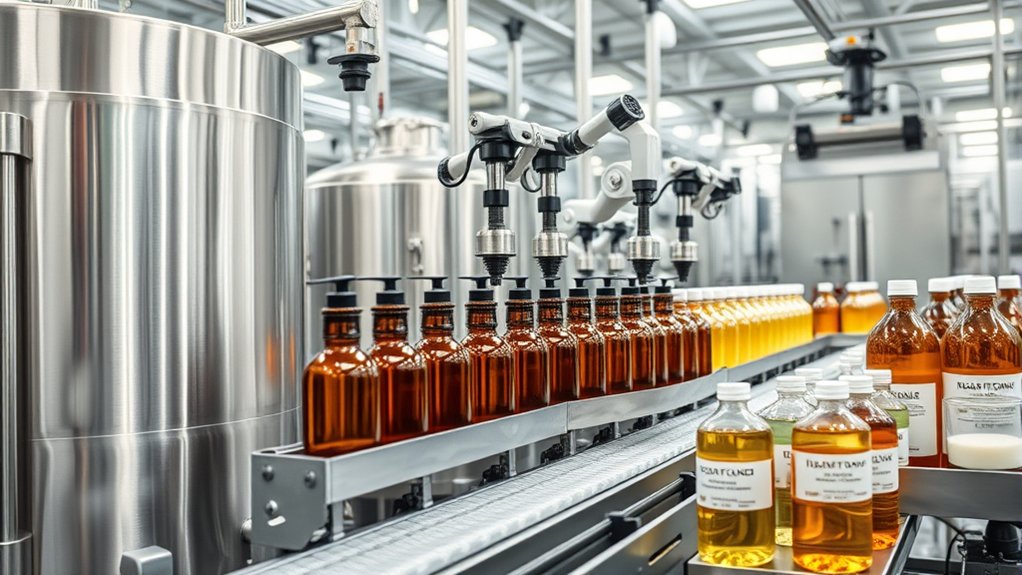
When you pick up a bottle of shampoo, you’re encountering a carefully balanced mixture where water makes up 70-80% of the formula. It serves as the main solvent that dissolves and disperses other ingredients.
Surfactants, which make up 10-15%, act as the primary cleansing and foaming agents. These include anionic, cationic, zwitterionic, and amphoteric types, each adding specific properties to the shampoo.
Conditioners usually account for 1-5% of the formula. They improve hair softness and manageability, often containing silicones or natural oils.
Thickeners, typically 0.5-1%, adjust the shampoo’s viscosity and texture. This helps guarantee ideal application every time.
Preservatives are present in minimal amounts, about 0.01-0.5%. Even though it’s a small percentage, they’re critical for inhibiting microbial growth and extending the product’s shelf life.
Understanding these components makes it easier to see how the manufacturing process mixes them precisely. This careful balance achieves a stable and effective shampoo formulation.
Why Good Water Quality Is Essential for Shampoo Manufacturing
You need to maintain strict water purity standards because water makes up 70-80% of shampoo and directly impacts ingredient solubility and product quality.
If there are impurities, they can change the texture, reduce how well the shampoo works, and make the formula less stable.
Plus, using high-quality water helps prevent microbial contamination, which keeps the shampoo safe and extends its shelf life.
Water Purity Standards
Because water makes up 70-80% of shampoo formulations, its purity directly impacts the product’s quality and effectiveness. You must adhere to strict water purity standards to prevent contaminants from triggering chemical instability or degradation.
Employing deionization and reverse osmosis guarantees water meets cosmetic-grade purity, eliminating dissolved ions and particulates that could compromise formulation integrity.
Quality control protocols rigorously monitor microbial contamination, as even minimal bioburden can reduce shelf life and pose safety risks.
Regulatory frameworks demand purified or deionized water use, underscoring its critical role in manufacturing. By controlling water purity precisely, you maintain formulation consistency and comply with safety requirements.
This forms the foundation for effective, stable shampoo products.
Impact on Product Quality
Although water makes up the majority of shampoo formulations, its quality profoundly affects the product’s clarity, stability, and performance. You must guarantee water quality is rigorously controlled because impurities like minerals and microbes can destabilize surfactants, compromising product quality.
Using purified water, commonly obtained through reverse osmosis, eliminates these impurities and prevents interference with the emulsification process critical for ingredient integration. High-quality water maintains the shampoo’s viscosity and texture, enabling consistent application and enhancing user experience.
Additionally, impurities in water can catalyze microbial proliferation, which undermines preservative efficacy and reduces shelf life.
Role in Ingredient Solubility
When manufacturing shampoo, the quality of water directly influences the solubility and hydration of other ingredients, which makes up 70-80% of the formulation. High-quality water, often purified through reverse osmosis, ensures ideal ingredient solubility by minimizing impurities and controlling water hardness.
You see, dissolved minerals like calcium and magnesium increase water hardness, which can mess with how surfactants work and reduce the shampoo’s cleansing power. The pH of water also plays a big role. Keeping it neutral to slightly acidic (between 5 and 7) helps active ingredients dissolve better and perform well.
Using deionized or distilled water is another smart move because it helps prevent microbial contamination. This, in turn, improves the shampoo’s stability and shelf life.
Step-by-Step Guide to Shampoo Manufacturing
The shampoo manufacturing process involves several precise steps to guarantee a consistent and effective product. You start by heating water to 130-140℉ (55-60℃) to hydrate ingredients properly.
Next, you add surfactants, which make up 10-15% of the formula, followed by conditioning agents and thickeners in a controlled sequence.
Using high shear mixing equipment like Silverson mixers helps ensure uniform blending, especially when incorporating immiscible components such as silicones.
After thorough mixing, you perform pH adjustment to reach an ideal range of 5-6. This enhances surfactant performance and product stability.
Throughout the process, rigorous quality control measures test for pH, viscosity, and microbial contamination. This confirms the shampoo meets all specifications before filling and packaging.
This methodical approach ensures product consistency and efficacy in shampoo manufacturing.
How pH and Viscosity Are Controlled During Mixing
Because pH and viscosity directly impact shampoo performance and user experience, you must control them carefully during mixing.
You adjust the shampoo’s pH to a target range of 5-6 using citric acid. This helps enhance cleansing and reduces scalp irritation.
Viscosity control relies on adding 0.5-1% thickeners, blended gradually to avoid globule formation. This guarantees a uniform consistency.
During mixing, you must continuously monitor pH and viscosity using automated systems for precision.
Continuous monitoring of pH and viscosity during mixing ensures precise control and consistent shampoo quality.
Add thickeners slowly to maintain stable viscosity and achieve the desired texture.
Also, perform quality control checks with viscometers to verify thickness at multiple production stages.
This systematic approach ensures product stability, consistent texture, and effective shampoo performance.
How Surfactants Affect Shampoo Performance and Manufacturing
You’ll want to get a good grasp on how different types of surfactants, like anionic and cationic, affect a shampoo’s foam quality and how well it cleans.
These molecules don’t just influence how ingredients mix together—they also play a big role in the product’s thickness and stability when it’s being made.
Surfactant Types Overview
Although surfactants make up only 10-15% of shampoo formulations, they play a critical role in determining cleansing efficiency and foaming characteristics. You’ll find different surfactant types tailored to specific functions in shampoo formulations.
- Anionic surfactants, like sodium lauryl sulfate, act as powerful cleansing agents, effectively removing oils and dirt.
- Cationic surfactants provide conditioning benefits by reducing static and improving hair manageability without compromising cleansing.
- Zwitterionic and amphoteric surfactants offer milder cleansing, ideal for sensitive hair, balancing lather quality with gentle performance.
Understanding how these surfactants work helps you optimize shampoo formulations for targeted cleansing strength and desirable lather quality.
This way, you ensure both performance and consumer satisfaction.
Impact on Foam Quality
When formulating shampoos, understanding how surfactants influence foam quality is crucial for balancing cleansing power and user experience. Surfactants, which make up 10-15% of formulations, reduce surface tension to trap air and generate foam. This foam is important because it enhances the perception of cleansing.
Anionic surfactants like sodium lauryl sulfate produce rich foam and efficiently remove oils. On the other hand, cationic types, while great for improving hair feel, tend to reduce foam volume. To boost foam stability without compromising cleansing, formulators often add foam boosters such as alkanolamides.
During manufacturing, factors like ingredient viscosity and surfactant choice directly affect foam characteristics. Using high shear mixing ensures uniform dispersion, which improves foam consistency and overall performance.
Role in Ingredient Blending
Surfactants not only shape foam quality but also play a central role in ingredient blending, directly impacting shampoo performance and manufacturing efficiency. You rely on surfactants, typically 10-15% of the formula, to deliver essential cleansing properties by trapping oils and dirt.
Effective ingredient blending demands precise control of three factors:
- High shear mixing: Guarantees uniform dispersion of surfactants, preventing phase separation and maintaining consistent viscosity.
- Surfactant balance: Anionic surfactants provide strong cleansing, while cationic types add conditioning, collectively influencing shampoo’s viscosity and foam.
- pH adjustment: Maintaining a pH of 5-6 optimizes surfactant activity, preserving mildness and effective cleansing on hair and scalp.
Mastering these parameters is vital for manufacturing shampoos with reliable performance and consumer appeal. It’s all about getting that balance right to ensure great results every time.
How High Shear Mixers Improve Shampoo Mixing
Because shampoo formulations often contain immiscible ingredients like silicones, high shear mixers play a critical role in reducing droplet sizes and achieving uniform emulsification. These mixers apply intense mechanical forces that rapidly blend liquids of varying viscosities, improving emulsification and ensuring consistent product quality.
By considerably reducing mixing times, high shear mixers increase production efficiency without compromising formulation integrity. Their closed-system design minimizes aeration, which helps prevent clouding and packaging defects common in conventional mixing.
High shear mixers boost production speed while preserving formulation quality and reducing aeration-related defects.
Furthermore, in-line high shear mixers enable continuous recirculation, enhancing blending efficiency. This technology also optimizes ingredient utilization by thoroughly integrating thickening agents, improving yield and performance.
When you employ high shear mixers, you streamline shampoo mixing processes and deliver a stable, homogenous product with superior texture and clarity.
Overcoming Challenges in Shampoo Manufacturing
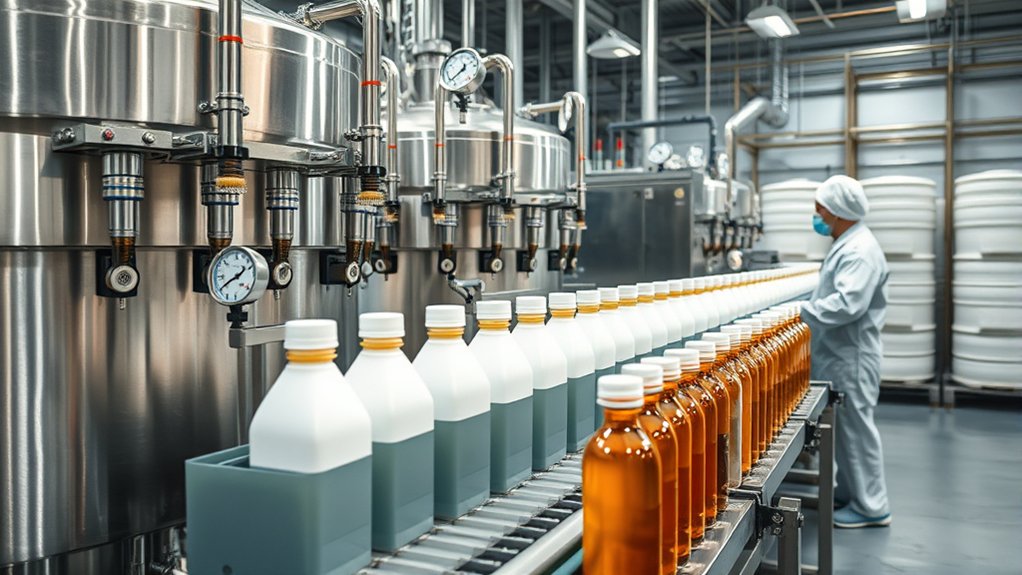
High shear mixers address many of the complexities in shampoo manufacturing, but challenges remain in achieving uniform blends because ingredients have different viscosities.
Plus, components like silicones don’t mix easily.
To tackle these issues, you need to use High Shear In-Line mixers. These mixers emulsify silicones effectively, making sure the product is consistent and clear. They also prevent aeration by using a closed-system design.
It’s important to optimize mixing times. This helps improve production efficiency without compromising the stability of thickening agents.
Also, make sure to implement rigorous quality control. Check pH and viscosity at multiple stages to ensure the shampoo meets formulation standards and stays stable throughout its shelf life.
The Role of Thickeners and Conditioners in Shampoo
You’ll come across thickeners like xanthan gum and hydroxyethyl cellulose in shampoos. These ingredients help control the shampoo’s viscosity, usually keeping it between 1,000 and 10,000 cps, which gives the product the ideal texture.
Then, there are conditioning agents such as silicones and quaternary ammonium compounds. These work by forming protective films on the hair shafts, making hair feel softer and easier to manage.
It’s important to understand how these components interact with each other and how the viscosity is carefully adjusted.
This knowledge is key to creating shampoo formulations that are both effective and stable.
Thickener Types Explained
When formulating shampoos, selecting the right thickeners is critical to achieving the desired viscosity and texture. This directly influences the user experience. Thickeners usually make up about 0.5% to 5% of formulations. They help balance product thickness without impairing performance.
Key thickener types include:
- Xanthan gum is a natural polysaccharide that provides stable viscosity and a smooth texture. It also enhances spreadability.
- Sodium chloride is commonly used to adjust viscosity in surfactant-based shampoos. However, it requires precise control to avoid destabilization.
- Hydroxypropyl methylcellulose is a synthetic polymer that offers consistent thickening and improved formulation stability.
Combining these thickeners with conditioners guarantees ideal hair manageability and sensory appeal.
Plus, it helps stabilize the shampoo to prevent ingredient separation. Your choice of thickener directly impacts shampoo performance and consumer satisfaction.
Conditioning Agent Benefits
Although thickeners and conditioning agents serve distinct functions in shampoo formulations, their combined effects are essential for delivering ideal hair care performance.
Conditioning agents, typically 1-5% of the formulation, enhance hair softness and moisture retention by coating the hair shaft with compounds like silicones and quaternary ammonium compounds. This coating reduces static and frizz, improving manageability and overall hair health.
Thickeners, comprising 0.5-2%, such as xanthan gum or hydroxyethylcellulose, adjust viscosity and stabilize the formulation, preventing separation and improving sensory experience.
Together, thickeners provide a rich texture that aids application, while conditioning agents improve detangling and preserve moisture.
Understanding their precise roles helps you optimize shampoo formulations for targeted hair care benefits. This way, you ensure product efficacy and keep consumers satisfied.
Viscosity Control Techniques
Building on the complementary functions of thickeners and conditioning agents in shampoo, controlling viscosity directly influences product performance and user experience.
You rely on thickeners like xanthan gum at 0.5%–5% to achieve the desired texture, while conditioners such as silicones contribute 1%–5%, enhancing feel and manageability.
Precise pH control (5–6) stabilizes both thickeners and surfactants, guaranteeing consistent viscosity.
High shear mixing guarantees uniform dispersion, preventing clumps.
To enhance viscosity, focus on selecting appropriate thickeners and conditioners within specified concentrations.
Also, maintaining pH helps preserve thickener and surfactant efficacy.
And don’t forget to use high shear mixing for homogeneity and stable viscosity.
This analytical approach guarantees shampoo delivers peak application and lathering performance.
Equipment Needed for Industrial Shampoo Manufacturing
Efficient industrial shampoo manufacturing relies on specialized equipment designed to guarantee product consistency and quality.
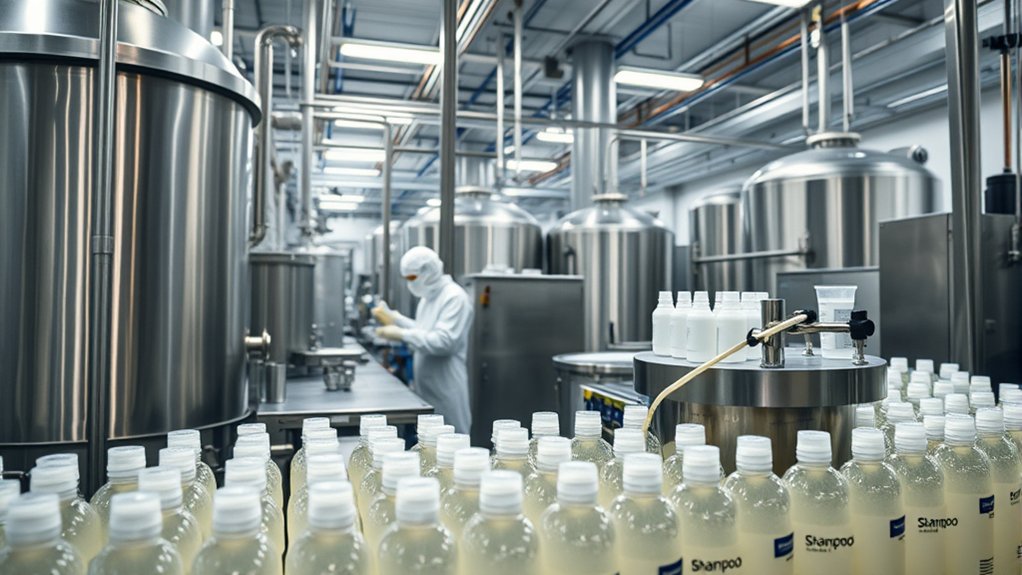
You’ll use stainless steel mixing tanks with agitators to blend large ingredient volumes, typically over 3,000 gallons. Emulsifying tanks equipped with high shear batch mixers create stable emulsions by thoroughly combining immiscible liquids. This is essential for silicones and conditioning agents.
Homogenizers then apply high pressure to break down particles, ensuring uniform texture and consistent product quality.
Automated filling machines handle precise transfer of the finished shampoo into various bottle types, optimizing production scale and efficiency.
Finally, water treatment systems, specifically reverse osmosis units, purify water. Water makes up 70-80% of shampoo formulations, so having a clean, controlled input is critical for maintaining formulation integrity throughout the manufacturing process.
Ensuring Consistent Shampoo Quality Through Testing and Control
To maintain consistent shampoo quality, you must implement rigorous testing and control measures throughout the production process. This guarantees every batch meets strict standards for ingredients, preservatives, and overall formulation integrity.
Key quality checkpoints include conducting pH, viscosity, and microbial testing at multiple production stages to monitor stability and safety. You’ll also want to sample each batch for stability tests that assess color, odor, and thickness. This helps confirm compliance with product specifications.
Monitoring detergent and preservative levels precisely is important to inhibit microbial growth and preserve efficacy throughout the shampoo’s shelf life.
Additionally, automated filling systems reduce human error, assuring accurate fill volumes. Regular audits verify that production processes comply with industry standards.
This way, you maintain consistent shampoo quality from raw materials to final product packaging.
Frequently Asked Questions
Can Shampoo Formulas Be Customized for Different Hair Types?
Yes, you can create custom formulations tailored to your hair type by adjusting ingredient variations precisely.
By analyzing market trends and consumer preferences, manufacturers optimize product effectiveness. This ensures shampoos address oily, dry, or sensitive hair effectively.
These custom formulations incorporate surfactant levels, conditioning agents, and actives to meet specific needs.
That way, performance and satisfaction are enhanced. This targeted approach boosts product relevance and keeps up with evolving consumer demands for specialized hair care solutions.
How Long Does Shampoo Typically Last on Store Shelves?
Think of shampoo’s shelf life as a ticking clock in a sealed bottle. Typically, it lasts 2 to 3 years on store shelves. This depends on precise storage conditions that help keep the product stable.
Expiration dates are there to guide inventory management. They make sure consumers stay safe by signaling when the shampoo’s effectiveness starts to fade. Keeping the shampoo away from heat and light helps it last longer.
Natural shampoos usually don’t last as long. They need stricter care to stop microbes from growing and to keep the quality up.
Are Natural or Organic Ingredients Used in Shampoo Making?
Yes, natural ingredients and organic alternatives are increasingly central in shampoo making. You’ll find ingredient sourcing prioritizes sustainability practices to minimize environmental impact.
Compared to chemical vs. natural formulations, organic shampoos often avoid sulfates and parabens, appealing to evolving consumer preferences for gentler, eco-friendly products.
This shift demands precise formulation adjustments to balance efficacy and shelf life while maintaining transparency about ingredient origins and certifications. It’s all about finding the right mix that works well and feels good to use.
Plus, being open about where ingredients come from helps build trust with customers.
What Environmental Impacts Are Associated With Shampoo Production?
Oh, you’ll love the shampoo industry’s environmental fan club: massive water usage, carbon footprint soaring as raw materials are sourced recklessly.
Chemical runoff contaminates ecosystems, while poor waste management means single-use plastics pile up endlessly.
If you care, look for biodegradable options, since conventional shampoos contribute heavily to pollution.
How Is Shampoo Packaging Selected and Designed?
You select shampoo packaging by analyzing packaging materials that suit product viscosity and chemical stability.
Design aesthetics must align with branding strategies to attract your target market. You also make sure label regulations are met by including all required information.
Consumer preferences guide your choices toward sustainability practices, like using recyclable materials. This helps enhance the eco-friendly appeal of your product.
It’s a smart move that resonates well with many buyers today. This precise approach balances functionality, compliance, and marketability.
It optimizes packaging performance while reinforcing brand identity in a responsible way. So, you get the best of both worlds—practicality and strong branding.
Conclusion
As you navigate shampoo manufacturing, remember it’s a delicate dance of chemistry and precision. Each ingredient, from surfactants to thickeners, plays a pivotal role, like instruments in a symphony. Controlling pH and viscosity guarantees your formula performs flawlessly.
Water quality acts as the silent conductor, guiding the blend. By mastering testing and equipment use, you transform raw materials into a consistent, high-quality product that cleanses and conditions with scientific elegance. It’s all about balance and attention to detail every step of the way.